Click here to visit our self-guided open house to learn about the project development.
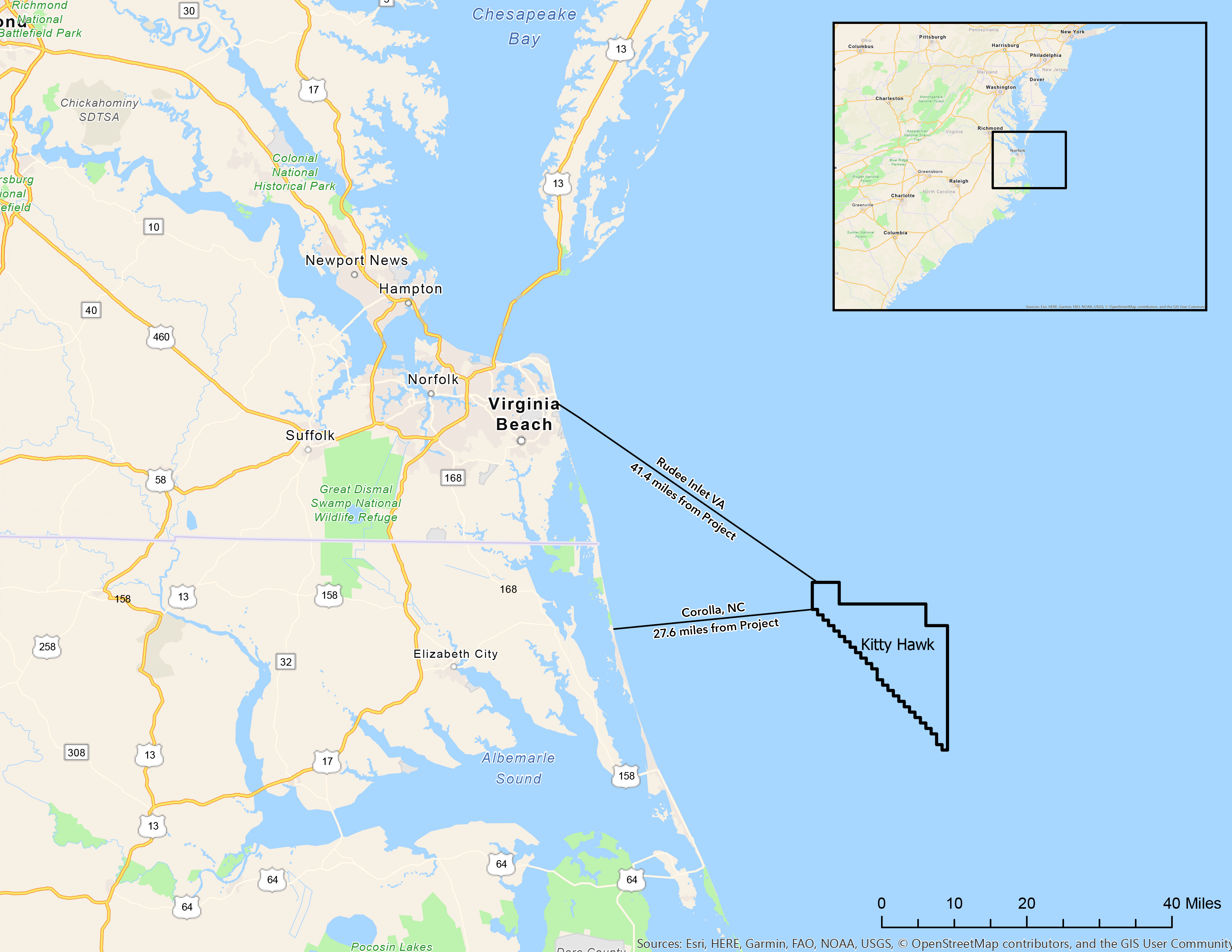
Kitty Hawk Wind is an offshore wind project proposed more than 27 miles from the Outer Banks. The Wind Energy Area is projected to be able to support 2,500 MW of electricity generation which would be enough to power approximately 750,000 homes.
The U.S. Bureau of Ocean Energy Management (BOEM) awarded Kitty Hawk Wind, LLC a 122,405-acre lease in 2017 for the development of an offshore wind project off the coast of North Carolina and Virginia. AVANGRID has been studying the area in more detail as part of early stage project development since then.
AVANGRID (NYSE: AGR) is an American clean energy leader that is part of the IBERDROLA Group, which is one of the largest offshore wind developers in the world. AVANGRID is at the forefront of transforming the way that the U.S. produces and uses energy.
The federal stakeholder planning and analysis phase focused on the identification and assessment of offshore areas that could be viable candidates for wind energy – Wind Energy Areas (WEAs). This process included nominations for particular areas, Environmental Assessments for specific activities related to this phase and public input.
Dec 12, 2012
BOEM publishes Call for Information and Nominations Learn More
Mar 7, 2013
BOEM Call for Information and Nominations Closes
Aug 11, 2014
BOEM Identifies Wind Energy Areas (WEAs) Learn More
Jan 23, 2015
BOEM publishes Notice of Availability (NOA) of Draft Environmental Assessment (EA) Learn More
Sep 18, 2015
BOEM Publishes Notice of Availability (NOA) for Revised Environmental Assessment and Finding of No Significant Impact (FONSI)
Learn MoreIn this phase, BOEM conducts a process to identify prospective bidders to lease an area offshore North Carolina for commercial wind energy development. BOEM manages an online auction process which results in a preliminary lease agreement for the highest bidder. The preliminary term for the lease is 12 months in which the lease must submit a Site Assessment Plan (SAP) to BOEM.
Aug 16, 2016
BOEM Releases the Atlantic Wind Lease Sale 7 Proposed Sale Notice (PSN) and Request for Interest (RFI) Learn More
Jan 18, 2017
BOEM publishes Final Sale Notice (FSN) Learn More
Mar 16, 2017
BOEM Holds Lease Auction Learn More
Mar 17, 2017
Kitty Hawk Wind, LLC wins Lease Auction Learn More
Mar 17, 2017
BOEM and Kitty Hawk Wind, LLC sign Commercial Lease for Renewable Energy Development Learn More
Following the establishment of a lease agreement, a Site Assessment Plan must be submitted to and approved by BOEM. The SAP describes the metoceanic data collection devices and methods to support site assessment activities. The data collection devices will monitor the wind resource and metocean conditions in support of the Project. Data collection will include the evaluation of: shallow hazards and geological conditions (including seabed constraints such as boulders and debris); marine archaeological resources; and benthic resources. Upon approval of the SAP, the lessee will have up to 4 ½ years in which to submit a Construction and Operations Plan (COP) to BOEM.
Sep 18, 2019
AVANGRID Submits Site Assessment Plan (SAP) Learn More
Apr 8, 2020
BOEM Approves SAP Learn More
Jun 7, 2020
MetBuoy Deployment Learn More
Dec 11, 2020
Submit Construction and Operations Plan (COP) Learn More
The focus of the Construction and Operations Phase is conducting the Environmental Impact Statement, receiving public input, and gaining approval on the Construction and Operations Plan. Following final approval of the plan construction and operations will begin.